Presentations on LTO Technology and DIY Digital Preservation at AMIA

CEO Linda Tadic will be presenting in two sessions at the Association of Moving Image Archivists (AMIA) conference in Baltimore, December 4th and 5th.   On Dec. 4th, Linda will present “It’s All On Tape: Case Studies in LTO Technology,” where’s she’ll describe Digital Bedrock’s use of LTO as its preservation storage media and give an update on LTO technologies.  On Dec. 5th, she’ll present “DIY Digital Preservation Tips for Independent Producers, Part 1: The Problems,” which is a brief overview of some of the topics presented at an International Documentary Association Workshop in September 2025.

The Association of Moving Image Archivists (AMIA) is the world’s largest international association of professional media archivists.  Digital Bedrock is proud to return as a sponsor this year and will have a booth in the Conference Pavilion (Booth #212).

More information here.

New Book "Digital Asset Management for Museums" With Contributions by CEO Linda Tadic

The recently published book “Digital Asset Management for Museums,” edited by Margaret McKee and Jessica Herczeg-Konecny, contains two sections written by Digital Bedrock CEO Linda Tadic. Within Chapter Two: Getting started: Putting DAM principles into practice with or without a Digital Asset Management System, she contributed the sections on digital preservation, and a spotlight on DAM and the environment.

The book is published by Bloomsbury: Find it here. 

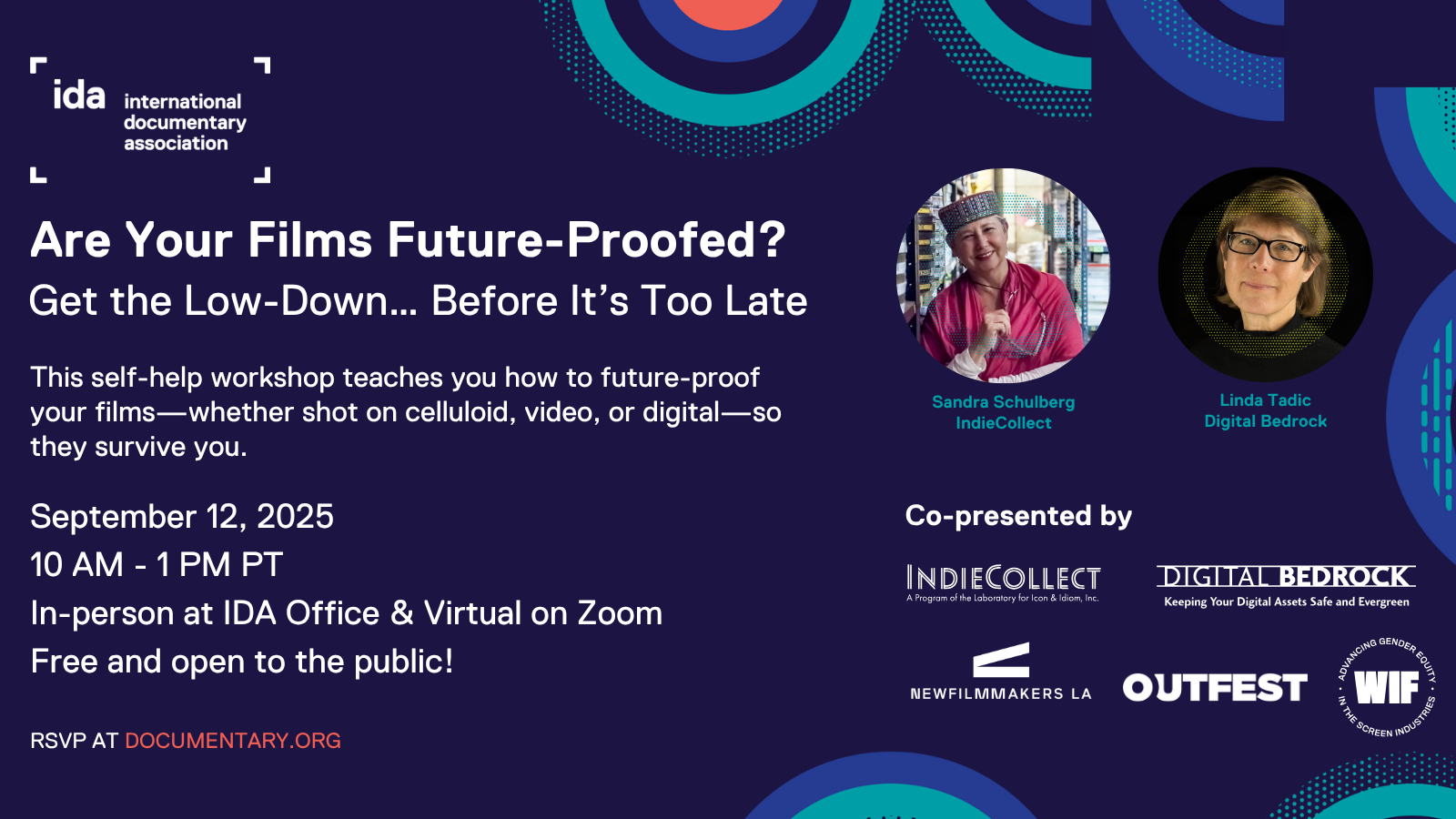
Are Your Films Future-Proofed? Get the Low-Down… Before It’s Too Late

Digital Bedrock is proud to partner with Indie Collect to present a free workshop guiding filmmakers on how to “future-proof” their films—whether shot on celluloid, video, or digital—so that they can be used in the future.  The workshop, which takes place Friday, September 12, 2025, 10AM – 1:00PM – PST, will include case studies (horror stories & happy endings) and DIY strategies.   Many filmmakers and media professionals have already suffered disasters: fire, floods, hard drives that don’t mount, cloud storage that goes “poof,” vinegar syndrome, mold.   Learn how to avoid these and other plagues before it’s too late.

You’ll come away from this session inspired and equipped with specific protcols for protecting your work.  This event is hosted by IDA and co-presented by Women In Film, Outfest, and NewFilmmakers Los Angeles.  

The panel will take place in person on Friday, Sept 12th at the IDA Office (3600 Wilshire Blvd. Suite 1810, Los Angeles, CA 90010).  For those who cannot attend in person, it will also take place on Zoom. This event is free and open to the public.

Digital Bedrock exhibiting at ARCHIVES*RECORDS 2024 in Chicago

Digital Bedrock will be at the Society of American Archivists ARCHIVES*RECORDS 2024 conference in Chicago August 15-16th.  Visit us at Booth No. 206 and learn why we are a unique leader in providing affordable, sustainable, and secure managed digital preservation services.   If you are among the thousands of archivists and records and information professionals from around the world attending the event, we look forward to meeting you during the Expo hours on Thursday, August 15th, 5:00 pm – 6:30pm, and on Friday, August 16th, 8:30 am – 5:00 pm.

Notable and Newsworthy

Digital Bedrock Founder and CEO Linda Tadic has recently been featured in two articles.  First, a SMPTE Spotlight profile highlights her leadership in the field of digital preservation, specifically regarding archiving and sustainability. 

Digital Bedrock is part of the Media Tech Sustainability Series for NAB 2024

Digital Bedrock is a proud to have earned the MTSS Sustainability Booth Stamp for the 2024 NAB show.   The Media Tech Sustainability Series is a collaborative non-commercial initiative with a mission to foster sustainability within the media tech sector.  MTSS partners with organizations within the media tech sector that champions sustainability, innovation, and responsible practices.

More info here.

CEO Linda Tadic to lead “Future-Proofing Digital Assets” Webinar

Traditional storage solutions often struggle with the complex workflows and demanding requirements of digital preservation.  Quobyte’s software-defined storage solution improves Digital Bedrock’s ability to manage client data prior to preservation. 

This webinar will highlight the significance of advanced storage in safeguarding digital assets and showcase a real-world application in use by Digital Bedrock.  CEO, Linda Tadic will explore the challenges that Digital Bedrock faced with their previous storage solution, including: bottlenecks that slowed down data processing and increased project completion times, complex configuration and maintenance requirements, and limited scalability to accommodate growing data volumes.

Participants will learn how Digital Bedrock's use of Quobyte for asset management overcame these digital archiving challenges with strategic insights and better efficiency.

Identifying Digital Content Created Using Generative AI

Creating content using generative AI is now a part of our lives that is here to stay. While there are occasions when content consumers are aware that AI tools were used, there are times when the source or provenance of AI-generated digital content is not transparent. This can lead to deepfakes (manipulated images or video) and other misleading information.

The Content Authenticity Initiative (CAI) works to build tools that can identify digital content created using generative AI. Some of these tools are developed to meet the technical standards set by the Coalition for Content Provenance and Authenticity (C2PA).     

Digital Bedrock has joined the CAI community. Our Digital Preservation Application (DPA) can already automatically extract C2PA metadata from image files as part of our standard digital preservation processing, and we are testing and expanding our tools adoption in other format and content types. Please follow our website and social media as we continue to implement services to help our clients identify generative AI content in their archives.

Missing Movies Interviews CEO Linda Tadic

Missing Movies is a nonprofit organization that seeks to publicize the problem of films that are unavailable for broadcast and home entertainment release due to rights/clearance issues, lack of available materials or “distributor indifference.”  Digital Bedrock CEO Linda Tadic was honored to be interviewed to talk about the importance for filmmakers to preserve their work, and on the current DIY state-of-the-art methods of digital preservation.

This consortium of film artists and professionals is working to save great films that have fallen into obscurity, one reel at a time. Read the “Missing Movies” Manifesto to gain a better understanding of what a “missing movie” means and how to make your movie more available by better understanding having the proper physical elements, as well as the permission of the copyright holder.

Digital Bedrock Completes Library of Congress Epubs Analysis

Through a contract with Digital Bedrock, the Library of Congress recently completed a project to analyze the technical characteristics of a substantial set of eBook and eJournal files in the Library’s permanent collection and available for onsite access in Stacks, the Library’s access system for rights restricted content, that will inform current action plans for access and preservation.

The project was started last June with an analysis of 150,000 files made up of formats such as EPUB, PDF, HTML, and XML.  Digital Bedrock’s Linda Tadic and Henry Rosen shared the results from their research and analysis at a recent summit hosted by the Library.    

Read more about the summit and its findings here.

Digital Bedrock to Assist the American Archive of Public Broadcasting

LOS ANGELES (February 10, 2023) Digital Bedrock, a provider of secure, managed digital preservation services, has been selected by the American Archive of Public Broadcasting (AAPB), to help in the preservation of historically significant public radio and television programs from producers and stations across the United States.

A collaboration between the Library of Congress and public media leader GBH in Boston, the AAPB digitizes, preserves and makes accessible this content.  A recent grant from the Mellon Foundation will support digitization of up to 150,000 items, doubling the current size of the AAPB collection.  

Approximately 4 PB of data will be produced from the digitization efforts.  Digital Bedrock will participate in the workflow by storing and maintaining preservation files awaiting ingestion by the Library of Congress. The company will receive digitized public broadcasting radio and TV programs, organize them, create checksums, write the files to 2 copies LTO8 media, and then perform annual fixity checks for the Library of Congress.  The work is set to begin by the summer 2023, with the timeframe for the entire project extending for several years. 

To perform this work, Digital Bedrock will use its appraisal and data organization tool, called the Data Appraisal and Reorganization Tool (DART).  This is a different system than Digital Bedrock’s core Digital Preservation Application (DPA), which performs full preservation, file metadata extraction, format validation, and obsolescence checks.  DART is used to select files received from clients based on the client’s appraisal policies, organize and rename (where required) batches of files, copy the data to a target destination, and initiate fixity (checksum creation and verification) actions.    

According to Linda Tadic, Digital Bedrock CEO and Founder, “The radio and television programs included in the American Archive of Public Broadcasting’s collections, originating from all sizes of public broadcasting stations across the United States and its territories, is an important record of American and even global history. The programs document news, history, and culture, at the local level to the national.  Digital Bedrock is honored to assist the AAPB’s important work.”

The AAPB contains nearly 100,000 items online available for the public to stream for free, dating back more than 70 years, with thousands more available for research access. Collections and content range from full episodes of groundbreaking public affairs programs like WNET’s Black Journal, unedited interviews recorded for series like Eyes on the Prize, the kid-driven ‘70s series ZOOM, and the entire “gavel-to-gavel” coverage of the Watergate Hearings. Exhibits delve into public media’s coverage of protests in America, Latino empowerment, Indigenous representation and much more. The AAPB was initiated by the Corporation for Public Broadcasting with a series of pilot projects before granting stewardship to the Library of Congress and GBH in 2013.

More information about this grant award can be found here: GBH press release.

Digital Bedrock Selects Quobyte’s Software-Defined Storage for Data Preservation Services

As part of Digital Bedrock’s services, the company incorporates online storage to analyze, process, and validate digital content before the files are brought through its digital preservation system.   It now utilizes Quobyte’s software-defined storage solution, which improves Digital Bedrock’s ability to manage client data prior to preservation.

At any one time up to 1 PB of storage can be stored on its local servers. These can be files from a variety of sources, including large media files, time- based artworks that can incorporate code and software, and digital works that contain thousands of individual files.

“Paradoxically, one of the significant challenges in providing exceptional digital preservation services is deletion,” said Linda Tadic, CEO, Digital Bedrock. “As preservation actions are completed, and multiple copies  are written to LTO media and stored in multiple offline locations, there is a need to delete large data volumes from the servers so we can continue processing new batches of client data. Quobyte’s ability to seamlessly integrate with the workflow makes deletion much easier.”

Learn more

Digital Bedrock Joins DNA Data

Storage Alliance

Digital Bedrock joins the DNA Data Storage Alliance to contribute to developing interoperability standards for DNA storage as an effective and eco-friendly solution to the explosive growth of data

Los Angeles, CA — May 16, 2022 —Digital Bedrock, an affordable, secure digital preservation service provider, is excited to announce that it has joined the DNA Data Storage Alliance.

Formed in October 2020 by Illumina, Microsoft, Twist Bioscience and Western Digital, the DNA Data Storage Alliance is the world’s first and most extensive alliance of industry, venture capital, academic and non-profit organizations in DNA data storage. The Alliance shares a mission to create and promote an interoperable storage ecosystem based on DNA as a data storage medium. This is done via public education, awareness raising, and the publication of white papers outlining the technology and its potential uses. Membership consists of a diverse range of stakeholders, combining a range of expertise, all essential for DNA data storage.

Linda Tadic, the Founder/CEO of Digital Bedrock commented: “We are looking forward to contributing to the Alliance’s work developing interoperable DNA data storage requirements for long-term preservation of digital content.  I am especially interested in the potential for DNA storage technologies to have less of an impact on the environment and earth’s natural resources than today’s traditional storage media and infrastructures.”

Learn more

Digital Preservation's Impact on the Environment: Free Webinar From the American Library Association

As part of its Preservation Week programming in April 2022, the American Library Association’s Core division presents a free webinar on digital preservation’s impact on the environment led by CEO/Founder Linda Tadic.  The general public is invited to participate. 

The one-hour free webinar will be held on Thursday, April 28, 2022, 11:00AM PST/2:00PM EST.  

This free webinar will explore the energy consumption and e-waste generated in current preservation infrastructures and actions, and review the environmental impact embodied in the full lifecycle of these infrastructures. It will include recommendations for actions and policies to mitigate digital preservation’s impact on the environment.

In addition to libraries and cultural heritage organizations concerned about their impact on the environment, the organizers invite the general public to participate this Preservation Week event as it will review digital storage media and technologies that individuals take for granted. 

At the end of this free webinar, attendees will be able to:
1. Be aware of their individual and organizational practices that could adversely impact the environment; 
2. Have ideas on how to change their practices.